Saturday, October 25, 2014

Spartacus - Junius

          Theoretically The Communist Manifesto, written by Karl Marx and Friedrich Engels, portray wonderful ideals without class structured struggles as well as briefly featuring the ideals of how the capitalist society would in time be replaced by Socialism, and then ultimately to Communism. 
          
          During the dilapidated time periods between late 19th and early 20th centuries, arose Rosa Luxemburg who had a profound role in German left wing politics.  Considered a Marxist theorist, philosopher, as well as an economist, she had successively been a member of Social Democratic Party of Germany (SPD), Independent Social Democratic Party (USPD) and the Communist Party of Germany (KPD).  Much of the martyrdom-like credit goes to Rosa Luxemburg along with others including Karl Liebknecht who founded what became the Spartacus League – they printed illegal anti-war pamphlets signing their documents “Spartacus” cleverly after the Thracian gladiator who liberated the slaves in opposition to the Romans.  Even during imprisonment for over two years during the war for her attempt to lead Germany’s proletariats to an anti-war general strike, it’s stated that her friends had helped smuggle and illegally publish her articles.  It is said that Rosa Luxemburg’s pseudonym was “Junius” after the Roman Republic founder Lucius Junius Brutus; hence, The Junius Pamphlet.

I found it really difficult to just pick and choose a section of the pamphlet.  In the first chapter, you can almost hear the frustration, the imploring in her voice asking why and what happened.  Their goals were within their grasps, their voices heard, the revolution of the working class, proletariats rising for control and then, the disillusioned and thwarted goal.

"And what did we in Germany experience when the great historical test came? The most precipitous fall, the most violent collapse. Nowhere has the organization of the proletariat been yoked so completely to the service of imperialism. Nowhere is the state of siege borne so docilely.[6] Nowhere is the press so hobbled, public opinion so stifled, the economic and political class struggle of the working class so totally surrendered as in Germany."

          Perhaps in a sense of atonement she reiterated the working class’s need as a “supreme duty” to reflect, self-criticize “for its weaknesses are only confusion.” 

“But German Social Democracy was not merely the strongest vanguard troop, it was the thinking head of the International. For this reason, we must begin the analysis, the self-examination process, with its fall. It has the duty to begin the salvation of international socialism, that means unsparing criticism of itself. None of the other parties, none of the other classes of bourgeois society, may look clearly and openly into the mirror of their own errors, their own weaknesses, for the mirror reflects their historical limitations and the historical doom that awaits them. The working class can boldly look truth straight in the face, even the bitterest self-renunciation, for its weaknesses are only confusion. The strict law of history gives back its power, stands guarantee for its final victory.Unsparing self-criticism is not merely an essential for its existence but the working class’s supreme duty. On our ship we have the most valuable treasures of mankind, and the proletariat is their ordained guardian! And while bourgeois society, shamed and dishonored by the bloody orgy, rushes headlong toward its doom, the international proletariat must and will gather up the golden treasure that, in a moment of weakness and confusion in the chaos of the world war, it has allowed to sink to the ground.
          Why did they give it up all almost as if they just gave up? Ah, ok I’m done with this, I’m outta here! kind of attitude one might even venture saying.  This topic came up during the lecture that perhaps they really in actuality wanted someone to tell them what to do or since they’ve voiced their concerns for better working environment and wages, perhaps they were satisfied that their concerns may have been heeded or at least perhaps they’ve gotten their satisfaction of seeing the havoc and damages that they can cause – like a giant rolling its feet causing destruction threatening it can do worse.
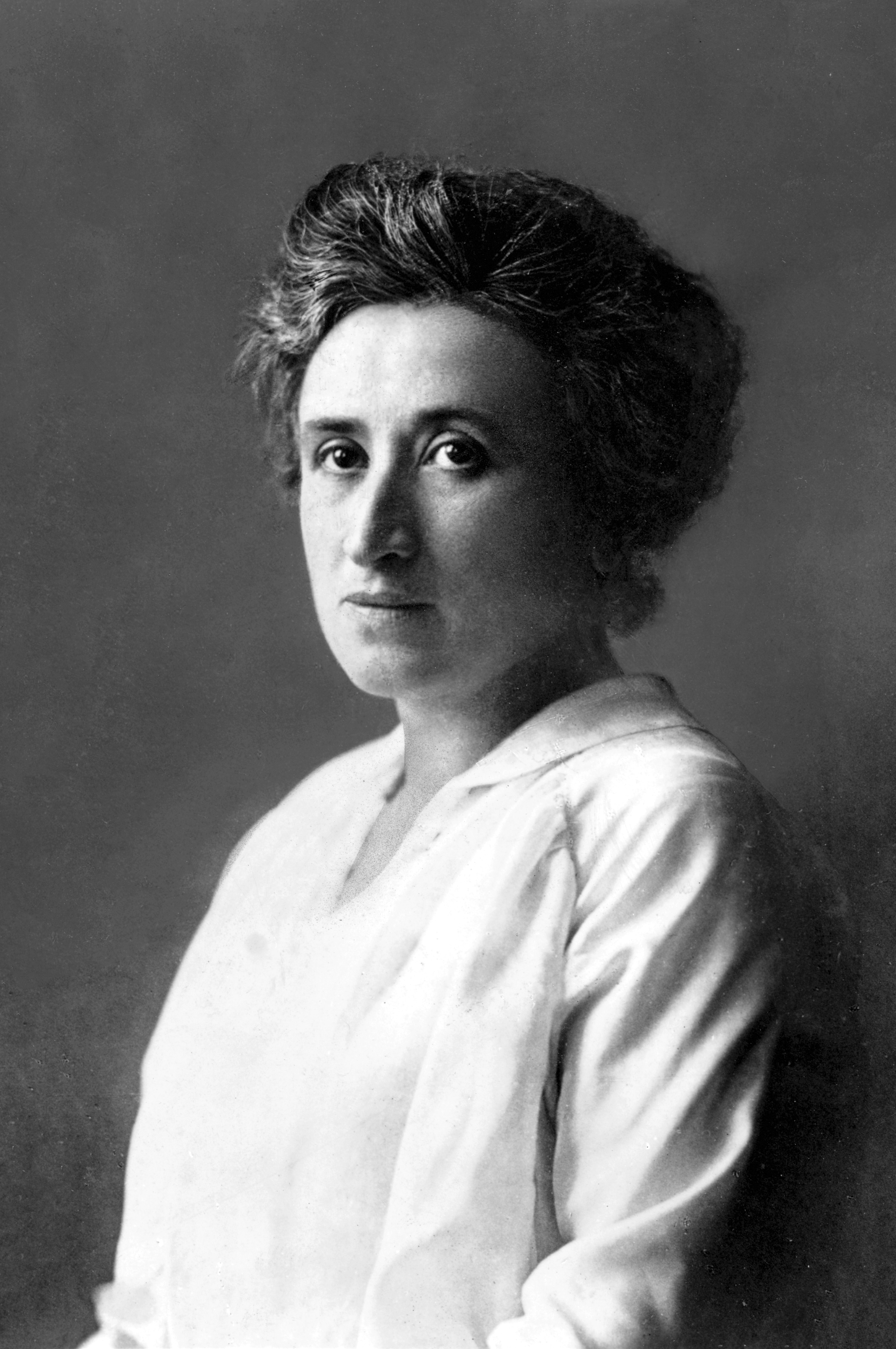


Rosa Luxemburg
Rosa Luxemburg also must have been a great orator; she pursuades, she voices, and lets you hear her emotions.  The imagery she portrays about criminals of the world war, the conclusion of the world war, its destruction and what the proletariats now need to do, in her own Marxist-Socialist-Communist ideals of course, is clearly evident in her later work What Does the Spartacus League Want?

“The class rule of the bourgeoisie is the real criminal responsible for the World War, in Germany as in France, in Russia as in England, in Europe as in America. The capitalists of all nations are the real instigators of the mass murder. International capital is the insatiable god Baal, into whose bloody maw millions upon millions of steaming human sacrifices are thrown.
The World War confronts society with the choice: either continuation of capitalism, new wars, and imminent decline into chaos and anarchy, or abolition of capitalist exploitation.
With the conclusion of world war, the class rule of the bourgeoisie has forfeited its right to existence. It is no longer capable of leading society out of the terrible economic collapse which the imperialist orgy has left in its wake.
Means of production have been destroyed on a monstrous scale. Millions of able workers, the finest and strongest sons of the working class, slaughtered. Awaiting the survivors’ return stands the leering misery of unemployment. Famine and disease threaten to sap the strength of the people at its root. The financial bankruptcy of the state, due to the monstrous burdens of the war debt, is inevitable.
Out of all this bloody confusion, this yawning abyss, there is no help, no escape, no rescue other than socialism. Only the revolution of the world proletariat can bring order into this chaos, can bring work and bread for all, can end the reciprocal slaughter of the peoples, can restore peace, freedom, true culture to this martyred humanity. Down with the wage system! That is the slogan of the hour! Instead of wage labor and class rule there must be collective labor. The means of production must cease to be the monopoly of a single class; they must become the common property of all. No more exploiters and exploited! Planned production and distribution of the product in the common interest. Abolition not only of the contemporary mode of production, mere exploitation and robbery, but equally of contemporary commerce, mere fraud.
          Oh how nice!  No one worker labors more or less than another.  Equal work, equal pay, collective labor for the good of all.  Boring and unchallenging however, I say it may work in theory, but we know it becomes dictatorship-like eventually in practice.  What’s your opinion?

Saturday, October 18, 2014

M (1931) - Fritz Lang

In as recent as 2010, the movie M had been ranked as one of the best films of the world cinema by a British Film magazine.  Reports indicated that Lang had based his movie M on real-life serial killers terrorizing Germany during that time in 1920s.


However eccentric Lang was in my opinion, he made possible the foreboding doom with increasing suspense of violence on the children without actually showing any violence.  However ironic, this is incredible insight by Lang as professor Murdaco also added in the lecture, that Germans at this time period were “essentially ‘desensitized’ to violence”. I suspect Lang left that to the audiences’ individual self-imagination of what horrific violence had been done to the children.  Perhaps I’m giving Lang too much credit since apparently in one of the interviews, Lang had told a reporter about his movie M simply that he made the film to caution and inform mothers to be aware about neglecting children.

Ah children. Innocent children and balloons, they so do love balloons don’t they?  Balloons of any kinds, types; balloons associate happiness, celebration, parties, something festive to look forward to!  At least, that’s how my kids are.  You know when you catch a glimpse of a helium balloon soaring into the sky, there’s a child sad nearby sighing.
 
I chose to depict the scene near the opening when Elsie’s abduction, disappearance, her demise was shown with her ball tossed aside rolling away ownerless, then Elsie’s balloon abandoned and adrift caught in the wires then lost over the wind.  It goes back to my opening paragraph that nothing needs to be said or shown to depict the calamity; use your imagination, lighten the situation however you want, but ultimately, the damage had been done.  The manipulative lengthy silence and black screen after the balloon scene also to me portrayed how silence, darkness, can also be in itself nihilistic; almost as how Freud explained our death drive – we have tendencies to spiral into depression and some of us even go further to take our lives.  In that sense, I agree with Freud’s feelings towards his explanation of “compulsive drive towards self-destruction”.

Sad, morose, depressing somewhat; smile, be happy, let your natural high, your endorphins kick in and drive you all away from the “death-drive”.

Saturday, October 11, 2014

The Blue Angel - Weimar Republic

Permit me to apologize for my tardiness; I was under the weather recently.  What was assumed to be a common cold turned out to a bacterial infection and I was unable to function properly.
              
               Anyway, allow me to discuss a bit about the movie.  The movie “The Blue Angel” is a classic!  It introduced Marlene Dietrich, one of the stars who played Lola-Lola, internationally.  For me, when the movie began, it was inspirational when I heard the movie open with the much familiar sounds of one of my favorite composers, Wolfgang A. Mozart.  "Ein Mädchen oder Weibchen wünscht Papageno sich!" ("A girl or a little wife, wishes Papageno") by Wolfgang Amadeus Mozart, from the opera The Magic Flute.  The movie took place in Weimar Germany wherein expressive artists were flourishing during the 1930’s.  We all basically should know the plot of the movie, so I won’t tell the story of the movie.  In any case, the following is the movie.


               In comparing the lecture, I feel that I can honestly argue that Rath, in marrying and enduring the relationship however miserable he was while Lola was cheating and deceiving him, can be said that the Id and the Ego had been acting its part within the psyche of Rath.  His Super Ego did not check or suppress his Id or Ego – moral values had been confronted and Rath was controlled by his Id.  Urges of his Id had been satisfied by marrying Lola even though it was clearly apparent that the two would end up in disaster.  Perhaps it just tells a story of the downfall of an esteemed man following his urges, then portraying the need for humility and the need to express kindness to others shown when Rath has to perform back at his hometown to endure the ridicules of his fellow colleagues and neighbors who at one point he himself had derided; what comes around goes around?  In my opinion, the movie definitely also introduced worldwide the new female stereotype of a vixen, strong and free-spirited, an uninhibited woman.


Cabaret Song #1:  "It's All a Swindle" (Alles Schwindel), by Mischa Spoliansky and Marcellus Schiffer (1931)
https://www.facinghistory.org/weimar-republic-fragility-democracy/culture/its-all-swindle-alles-schwindel-mischa-spoliansky-and-marcellus

              OMG!  What a dreadful song.  It has an upbeat of a typical cabaret two-step music and cheerful tempo, but the lyrics just portray dismay.  I chose the following parts of the song; I had to include the chorus section also.  I can almost sense the emptiness of the people struggling just to survive; everyone is out for themselves, there is no innocence of youth nor order, or discipline.   One’s life can end suddenly, there’s a sense of chaos, but life goes on.  It’s a catch-22; there is no ‘good’ deal or fair exchange of goods, it’s not if you can get away with it then do it, it’s more like do it and get away period -  there’s a saying, a good con can steal your underwear even while you’re looking.

Excepts from English translated lyrics:

Life's a swindle, yes, it's all a swindle
so get what you can
from your fellow man
Girls and boys today
would rather steal than play
and we don't care

We tell them get your share
Life is short and greed's in season
all mankind has lost its reason
life is good, knock on wood, knock, knock
Shops will swindle shoppers swindle

every purchase hides a tale
The price is inflated
or regulated
to ensure the store will fail
Wheel and deal and pull a fast one
knowing you won't be the last one
get the goods while they are going
grab the cash while it is flowing
Everyone swindles some
what the heck go bounce a check

Excerpts from German lyrics:

Alles Schwindel, alles schwindel,
überall wohin du guckst
und wohin du spuckst!
Alles ist heut ein Gesindel,
jedes Girl und jeder Boy,
’s wird einem schlecht dabei!
’s wird ein’m schwindlig von dem Schwindel,
alles, alles, alles Schwindel,
unberufen toi! toi! toi!

Kaufmann schwindelt
Käufer schwindelt,
mit dem höflichsten Gesicht!
Man schwebt in Ängsten,
nichts währt am Längsten,
also warum soll man nicht!
Jede freundliche Verbeugung,
jede feste Überzeugung,
Preisabbau, solide Preise


Cabaret Song #2:  "No Time" (Keine Zeit), music by Rudolf Nelson, lyrics by Herbert Nelson
https://www.facinghistory.org/weimar-republic-fragility-democracy/culture/no-time-keine-zeit-music-rudolf-nelson-lyrics-herbert-nelson

               The great depression era along with Germany paying retribution to other countries affecting the economy, the following excerpts from the song “No Time” seems to portray the perfect imagery of a typical worker, whether blue or white collar, struggling, rushing daily to make ends meet.  If you are told you have an 18-hour shift or they don’t need you, I suppose you abided – no sleep, no rest.  I love the irrational and sarcastic reference of the businesses and the economy through the imagery of falling in love one evening, to marriage the following morning, to a divorce that night.  Contrastingly to the first music I chose which had an upbeat music conversely to its dreadful lyrics, it seems “No Time”, although the lyrics sound hastened or the lyrics gave the impression the music will have a quicker tempo, it had a laid back Broadway “Gone with the Wind” type of tune – but it does incorporate a perkiness or even bounciness in its music.

Excepts from English translated lyrics:

No time, no time, no time.
Yes, we have no time.
Sorry, but we're always on the go,
with tongues hanging out as we run.
We have no spare time.
No time, no time, no time,
no hours nor even a second to spare.
We hardly sleep, we don’t rest.
No time, no time, no time.
Nowadays, a person doesn't have a second to spare.
Yet many even think the pace is too slow.
If you do business today, you go bankrupt before you have even started.
People don't want to waste time with the beginning,
they'd rather skip straight to the end.
In this day and age, you fall in love in the evening, are engaged at night,
and get married the next morning.
At noon you have a fight; by night you're divorced.
In negotiations between countries, before a treaty is evened signed,
it's already broken.
Because nowadays it is considered chic to be quick.


Excerpts from German lyrics:

Keine Zeit, keine Zeit, keine Zeit. Ja, wir haben keine Zeit. Es tut uns leid.
Wir sind immer auf dem Sprung, haengt uns raus schon die Zung und doch wir rennen, ja wir kennen keine Zeit.
Keine Zeit, keine Zeit, keine Zeit, keine Stunde und Sekunde haben wir Zeit. Ja, wir schlafen heute kaum noch, denn wir ruhen uns nicht aus. Keine Zeit, keine Zeit, keine Zeit.

Man laesst sich weit und breit heut nicht mehr Sekunde Zeit heut.
Es geht im Gegenteil uns noch zu langsam fast.
Machst du Geschaefte heute, bist du bereits schon pleite, bevor du ueberhaupt noch angefangen hast.
Man moecht am liebsten, ja das soll’s geben, das Ende noch vor Beginne leben.
Heut verliebt man sich abends, verlobt sich bei Nacht und vermaehlt in der Frueh sich zufriede und am Mittag da hat man bereits sich verkracht und am Abend ist man wieder geschieden.

Findet heut zwischen Laendern Verhandlungen statt und die Herren haben alles besprochen, ja dann wird noch bevor unterzeichnet man hat, der geschlossene Vertrag schon gebrochen,
denn das findt man heut chick, denn wir sind ja so quick.
Es ist gleich, ob wir heute reell sind, denn die Hauptsache ist, dass wir schnell sind.


Paragraph 175

               Talk about homophobic!  Of course with the Nazi’s coming to power it was perceivable that order would be enforced especially when flourishing expressionists had awhile been communicating to the public via music, plays, cinema as well as print media expressing their thoughts and opinions including their sexuality; it had to be put to a halt!  The Aryan supremacy mentality had been rising and homosexuality was one of the first to be targeted.  However, Lesbians and females in general have not been included in Paragraph 175 unless if an animal had been involved according to the amended Paragraph 175b.
               
               Correct me if I’m wrong, but the amended law seems to state even if an unwilling male who had been forced, or “allow himself to be abused”; “allowed” himself to be abused?  If forced, how is that allowing? If I couldn’t fight it off, I’m guilty according to Paragraph 175.  My feeling about this law in comparison to the lecture is mainly about freedom, our rights, and the interpretation of the idea of freedom.  Whether it centers on homosexuality, Paragraph 175 was to the Germans at the time, a physical obstacle, a barrier in the embodiment the freedom that Kant attempted to interpret.  Much like how Kant argued that freedom must be law-like, it’s apparent the law irrationally took away a certain freedom – Kant’s argument works both ways.  As is with any rules and regulations governing our society and following, abiding by or conforming to the ‘norm’, I have to agree with Kant in that our actions are based on or determined by external stimuli, then we do not really have free will.  However, free will can be said as the ability to choose – we do have free will in that sense since we are choosing either to conform or end up penalized.  It’s not precise, sort of vague even, but I do grasp Kant’s theory in his argument.